
Every September, the back-to-school rhythm returns and we instinctively think about learning. But what if the lesson we need most right now isn’t learning at all – but unlearning.
Because the deepest growth doesn’t always come from adding new knowledge. It often comes from letting go – unlearning old patterns, beliefs, and assumptions about the world.
Why Unlearning Matters
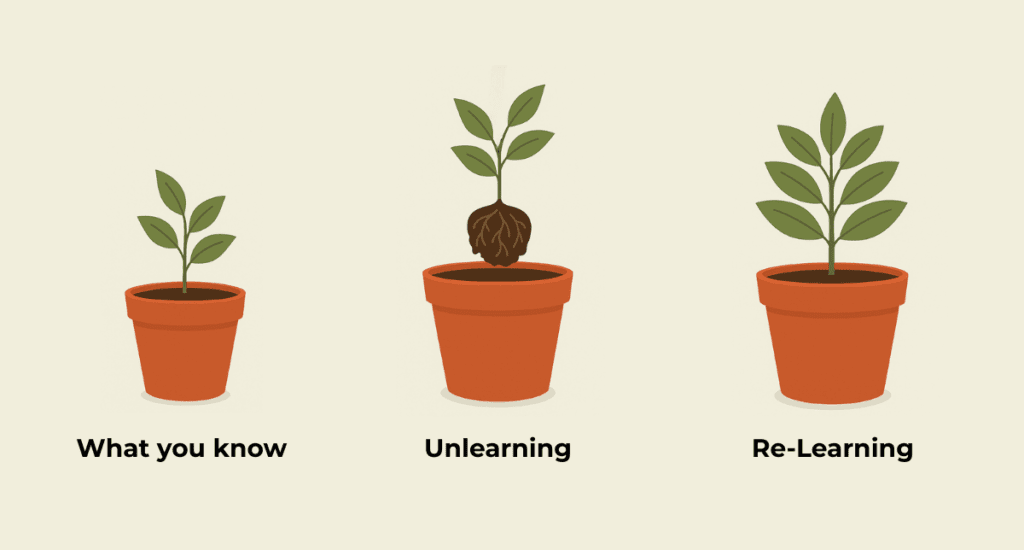
Learning is about adding to our knowledge. Unlearning is about making space; letting go of outdated beliefs, flawed assumptions, and comfortable but incomplete truths.
And in a world where things are changing so rapidly, unlearning becomes even more important. What worked yesterday might no longer apply today. What once felt certain may not hold true in a new context. Without the capacity to unlearn, organizations risk clinging to ideas that no longer serve them.
The Hidden Cost of Assumptions
In every aspect of our lives, certain “truths” take hold. Assumptions so common that they often go unchallenged:
- “Wealthy clients only care about returns, not values or impact.”
- “Privacy concerns only matter to older generations.”
- “Low voter turnout means people don’t care about politics.”
- “Older patients don’t want to use digital health tools.”
- “People who don’t get vaccinated are simply anti-science.”
The problem with these narratives is that they’re overly simplistic. They erase nuance, exclude the experiences of many, and prevent people from fully being seen. They also act as blinders; narrowing our vision and keeping us from seeing the full picture.
Simple stories may be easier to tell; but they almost always leave someone out. And when they do, they stop us from seeing the full picture.
Data as a Mirror, Not a Map
Data isn’t just here to teach us something new. It’s here to help us unlearn the stories holding us back.
Too often, we treat data like a map and as a tool to point the way forward. But what if we treated it like a mirror? A reflection not only of what is happening, but of where our perceptions have been wrong.
In my work, the most meaningful breakthroughs come when data doesn’t confirm what a client already believes, but forces them to pause and reconsider. That moment of tension – between the story we’ve been telling ourselves and the story the data is telling us – is where unlearning happens. And it’s in that space that innovation begins.
The Challenge of Letting Go
There’s another reason unlearning is so powerful: it’s harder than learning.
When we learn, we build new neural pathways. When we unlearn, we’re not just building new ones – we’re also pruning back the old ones. It’s rewiring at a deeper level. That’s why even when the evidence is clear, people often hold on tightly to familiar stories.
In many ways, unlearning requires more courage than learning. It asks us to release the comfort of certainty and step into ambiguity.
The Personal Side of Unlearning.
The concept of unlearning isn’t just a professional idea for me. Through my own therapy journey, I’ve experienced firsthand how unlearning plays out on a personal level. Unlearning old patterns of thought, reframing beliefs about myself, and challenging ingrained ways of responding have all been far harder, and more rewarding, than simply “learning” new tools.
The same principle shows up in the data work I do. At Environics Research, we use social values research to uncover the deeper motivations driving people’s decisions. These values help us see things from different angles and often force clients to confront assumptions they didn’t even realize they were carrying. This data doesn’t just help us learn more about people but helps us unlearn the stories we’ve oversimplified about them.
Values data doesn’t just reveal what people believe – it helps us unlearn the stories we’ve oversimplified about them.
The Skill of Unlearning
Unlearning is not passive. It requires three things we don’t often celebrate in business
- Humility – the willingness to admit that what once worked may no longer serve us.
- Curiosity – the openness to see contradictions not as threats, but as invitations to go deeper.
- Agility – the ability to shift course when the evidence demands it.
In this way, unlearning is the harder work. Learning adds; unlearning strips away. But if learning helps us grow, unlearning helps us evolve.
Switching the Script
So yes, September reminds us to keep learning. But the lesson that doesn’t show up in any textbook is this: to move forward, we must also unlearn.
The next time you’re faced with data, don’t just ask: What can we learn? Ask instead:
- What belief do we need to unlearn?
- What assumption no longer holds?
- Where is the nuance that challenges the story we’ve been telling ourselves?
Because in a world changing faster than any syllabus can keep up with, unlearning may be the most valuable lesson of all.