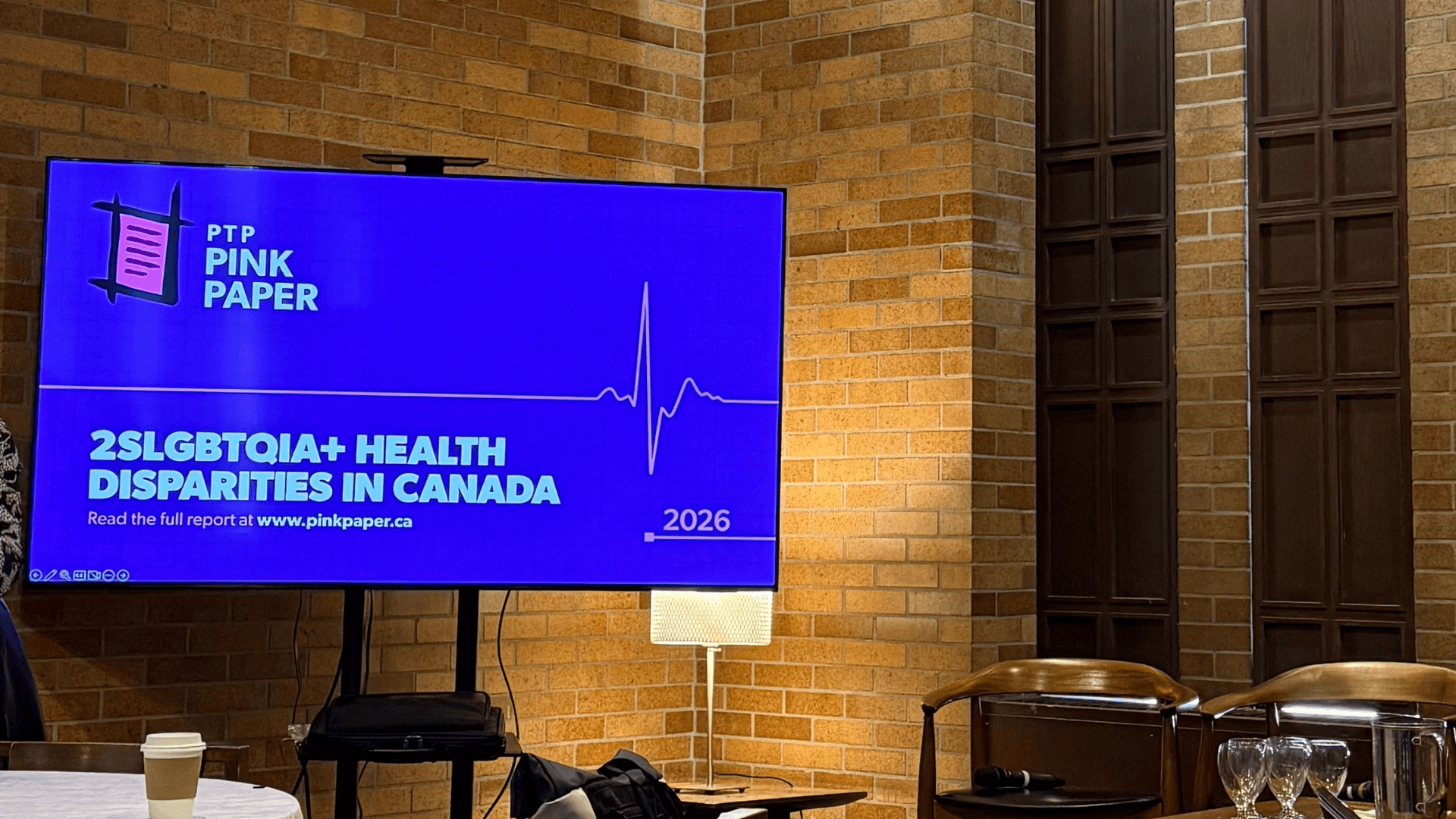
Last week, a piece of work I’m genuinely proud of was released publicly: The Pink Paper on 2SLGBTQIA+ Health Disparities in Canada, created in partnership with Pink Triangle Press and my team at Environics Research. Since the release event, I’ve been sitting with a quiet sense of pride. Not just in the research itself, but in what it makes visible, and how it’s being positioned for action. It tells the truth about people’s lives in a way that’s hard to dismiss.
Why this mattered to me
I’ve spent the last decade at Environics Research working on projects that were impactful and have influenced change. But this one carried an extra sense of responsibility, and it mattered in a different way as someone part of the 2SLGBTQIA+ community. I’ve watched friends navigate healthcare with a level of caution most people never have to think about: deciding what to disclose, wondering whether they’ll be treated differently, bracing for being misunderstood, judged, or flat-out not believed. Some have faced racism, homophobia, and transphobia in care settings. A few have even been refused care. What this research makes clear is that these aren’t “edge cases.” They’re part of the context many people carry into every interaction they have with the healthcare system.
At the same time, working on this study made me reflect on my own experience and how much it doesn’t resemble the worst of what the data shows. I’ve had access to queer-positive care through a queer physician. I know how to advocate for myself. I understand how the system works and how to navigate it. Reading these findings reminded me that those things are not universal. Seeing the gap between my experience and what others report wasn’t comfortable, but it was clarifying and it reinforced why this research is needed.
The approach behind the numbers
The Pink Paper is built on a national, bilingual, and comparative foundation: a cross-sectional survey of 2,100+ people across Canada, with roughly half identifying as 2SLGBTQIA+, paired with qualitative conversations with community and healthcare leaders. The goal wasn’t simply to measure disparities; it was to understand them with enough specificity that the results could actually be used; by educators, providers, funders, policymakers, and community organizations pushing for change.
One of the things I’m proudest of is how the research was designed. We didn’t treat this like a generic health survey with a few identity questions added at the end. We approached it with the understanding that trust and safety aren’t “nice-to-haves” in healthcare; they shape whether someone gets care at all. We learned from people who live and breathe these issues every day, and we tried to build something that reflects nuance: how disclosure works, how stigma shows up, how “good care” is felt, not just delivered.
The report captures that tension in a line that’s stayed with me: “Approaching data in the aggregate obscures serious health concerns that affect specific communities.”
That’s the risk with flattening experiences into a single average: inequity can disappear in plain sight. And if it disappears in the data, it disappears in priorities, budgets, training, and policy.
This isn’t unique to 2SLGBTQIA+ communities. The same thing happens whenever we treat “the population” as a single story – especially for equity-deserving and low-incidence groups whose experiences are often diluted or lost in the averages: immigrants, racialized communities, Black communities, and people living with disabilities, to name just a few
The numbers that stayed with me
Some of the findings are hard to sit with; not because they’re surprising, but because they quantify what so many people in the community already know anecdotally:
Mental health is one of the clearest signals. In the survey:
as a main health concern, compared to 31% of non-2SLGBTQIA+ respondents.
But it isn’t just prevalence. It’s also what happens when people try to get help:
And when people can’t access care they trust, they adapt:
Discrimination is another major thread and the report makes clear it isn’t “rare”; it’s patterned. One of the most telling findings isn’t just that discrimination happens, but what it looks like in practice. Compared with non-2SLGBTQIA+ respondents, 2SLGBTQIA+ respondents were:
- More likely to report having to explain their identity to healthcare professionals (39% vs. 19%),
- More likely to hide aspects of themselves (36% vs. 20%), and
- More likely to feel discomfort or lack of safety in healthcare settings (35% vs. 23%).
This is where the intersectional lens matters most. And I mean that in two ways:
- “2SLGBTQIA+” can’t be treated as one experience. Even within mental health care satisfaction, the report shows wide variation across identities, which means a single “LGBTQ+ average” can hide who is struggling most.
- Disparities intensify when identity intersects with broader realities. Social determinants like income, education, and geography amplify impacts on quality of life and mental health outcomes, and experiences of discrimination are noted as more prevalent among racialized and rural respondents, underscoring compounded marginalization.
That’s why disaggregated, nuanced data isn’t a “nice to have.” It’s the difference between a healthcare system that can truly see what’s happening and one that keeps missing people in plain sight.
Where we go from here
Even though it’s hard to look at some of this data head-on, I’m hopeful. The fact that we’re finally collecting it in a way that’s nuanced, community-informed and community led is progress in itself. It gives us a clearer starting point: not just to acknowledge disparities exist, but to understand where they show up, for whom, and why.
One of the most energizing parts of this work was speaking with community leaders and people building solutions on the ground. Many are doing far more than should be asked of them, often within under-resourced organizations, yet they’re doing it with strategy, care, and a deep understanding of what people actually need. Those conversations left me confident this research won’t just be interesting. It will be useful, and it will be leveraged to strengthen advocacy, back up what people have been saying for years with evidence decision-makers can’t ignore, and push for concrete changes in how care is funded, designed, and delivered.
I’m deeply grateful to Pink Triangle Press for trusting us with this work and for being such a thoughtful partner throughout. This project reminded me why purpose-driven research matters. And I’m excited because this research isn’t being left to sit on a shelf. It’s already being used to help launch Script, a one-stop editorial destination for credible, community-informed 2SLGBTQIA+ health reporting.
As part of PTP’s long-standing mission to serve the 2SLGBTQIA+ community through trusted, independent journalism for more than 50 years, Script is supported by three tailored newsletters: Dose (targeted health information for queer men), Vital (essential health information for queer women), and Signal (credible, affirming coverage created by and for trans and gender-diverse communities).
To me, that’s what it looks like when data becomes leverage: not just publishing findings, but translating them into information people can actually use, and education they can access and trust. It’s also about putting tools in place that can support advocacy, training, service design, and broader system change.
If you influence healthcare, policy, education, or community services, I hope you’ll take the time to read The Pink Paper and follow the work coming out of Script. This is how evidence starts to move through the system, and how it can begin to make meaningful change in people’s lived realities.