
On September 16, 2026, a study released by the American Journal of Preventive Medicine concluded that “emergency room visits for gambling disorders have nearly doubled since Ontario opened its online gambling market to private companies and sports betting, with males aged 10 to 29 accounting for the biggest increases.” Why do young males experience gambling problems disproportionately? And are Gen Z men especially susceptible to this problem compared to past generations?
Environics Research’s Social Values database extends over a 30-year period. This long span gives us a unique and valuable capability: we can see whether different generations express different values at the same stage of life. It’s well known, for example, that young people on average are more attracted to risk-taking than older people; the appetite for risk tends to diminish with age. Our decades of research data let us examine not just whether people in their 20s today are more attracted to risk than those in their 50s, but whether those in their 20s today are more attracted to risk than today’s fifty-somethings were when they were in their 20s. This analysis sheds light on how people’s values evolve throughout their lives, and whether the effects of age differ from one generational cohort to the next.
The Social Values study does not seek to track specific behaviours such as gambling or investment activity; rather it seeks to capture the mindsets associated with such behaviours, which can help to illuminate why people engage in certain activities.
Specifically, the Social Values study tracks several values that influence gambling activity:
Risk and intensity
Our study explores the extent of people’s attraction to risky and impulsive behaviours, and the intense emotions that risk-taking and impulsivity can deliver.
Financial outlook
We study people’s inclination toward financial concern (or optimism) at the psychological and emotional level, apart from their real financial circumstances.
These are all values that Environics tracks and that may influence an individual’s decision to engage in gambling activities. Furthermore, concerns about financial security and the future may also shape how individuals choose to manage their money.
Risk and intensity
Many people remember their youth as a time of intense emotion: desperate crushes, dramatic teenage despair, rash anger, a powerful appetite for thrills and fun. Our Social Values data supports the idea that emotions and impulses have special power over the young. Those in their late teens and early 20s are much more likely to agree with statements such as, “I like to experience new emotions every day” and “I get pleasure out of letting myself go along with an impulse or passing emotions.” Across generations, the data does not indicate a large shift from one cohort to the next when it comes to seeking intense emotions and impulsive behaviours. Today’s 50-year-olds were, during their youth, much the same as today’s 20-year-olds: exploring their emotions testing the balance between self-control and letting go.
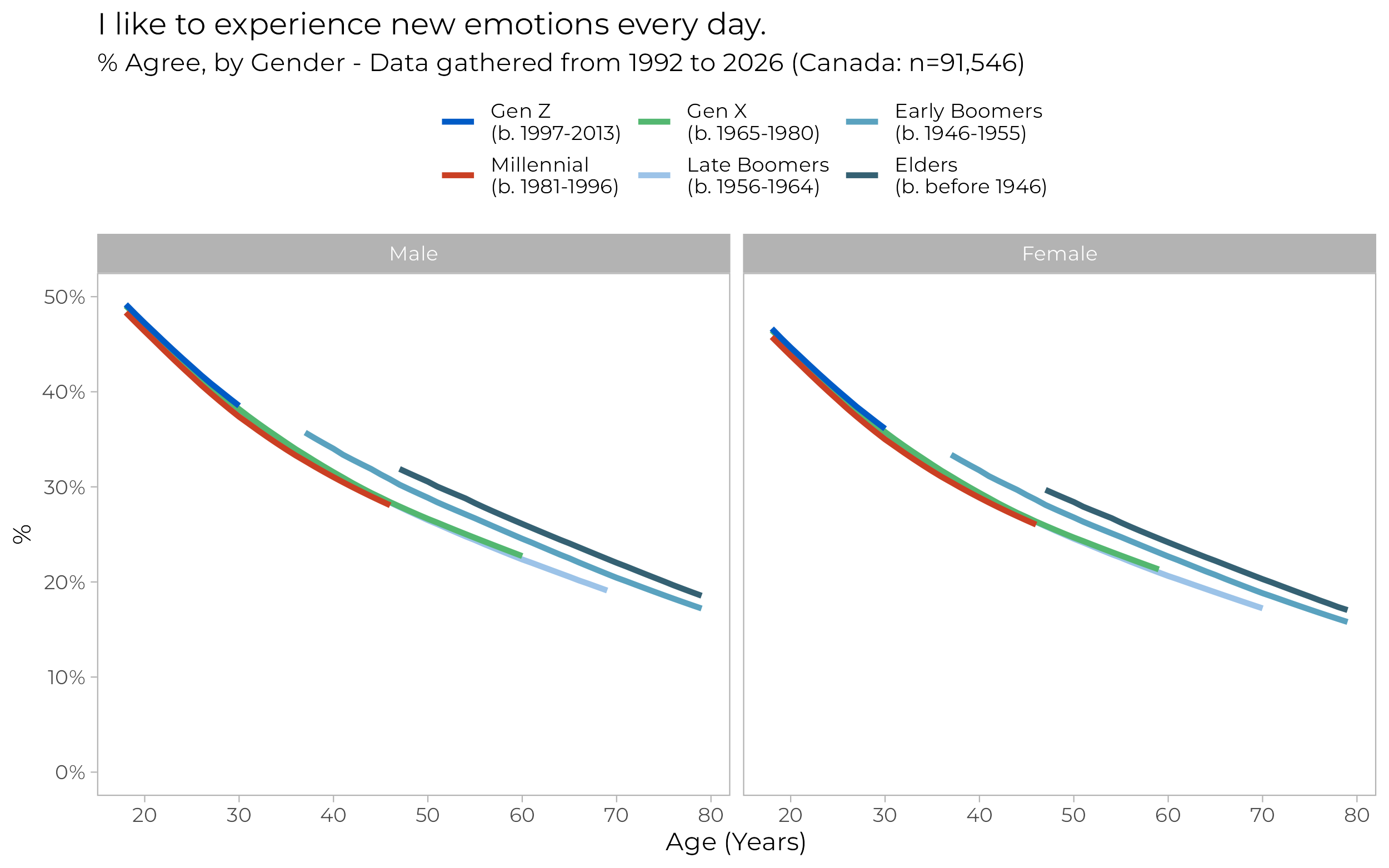
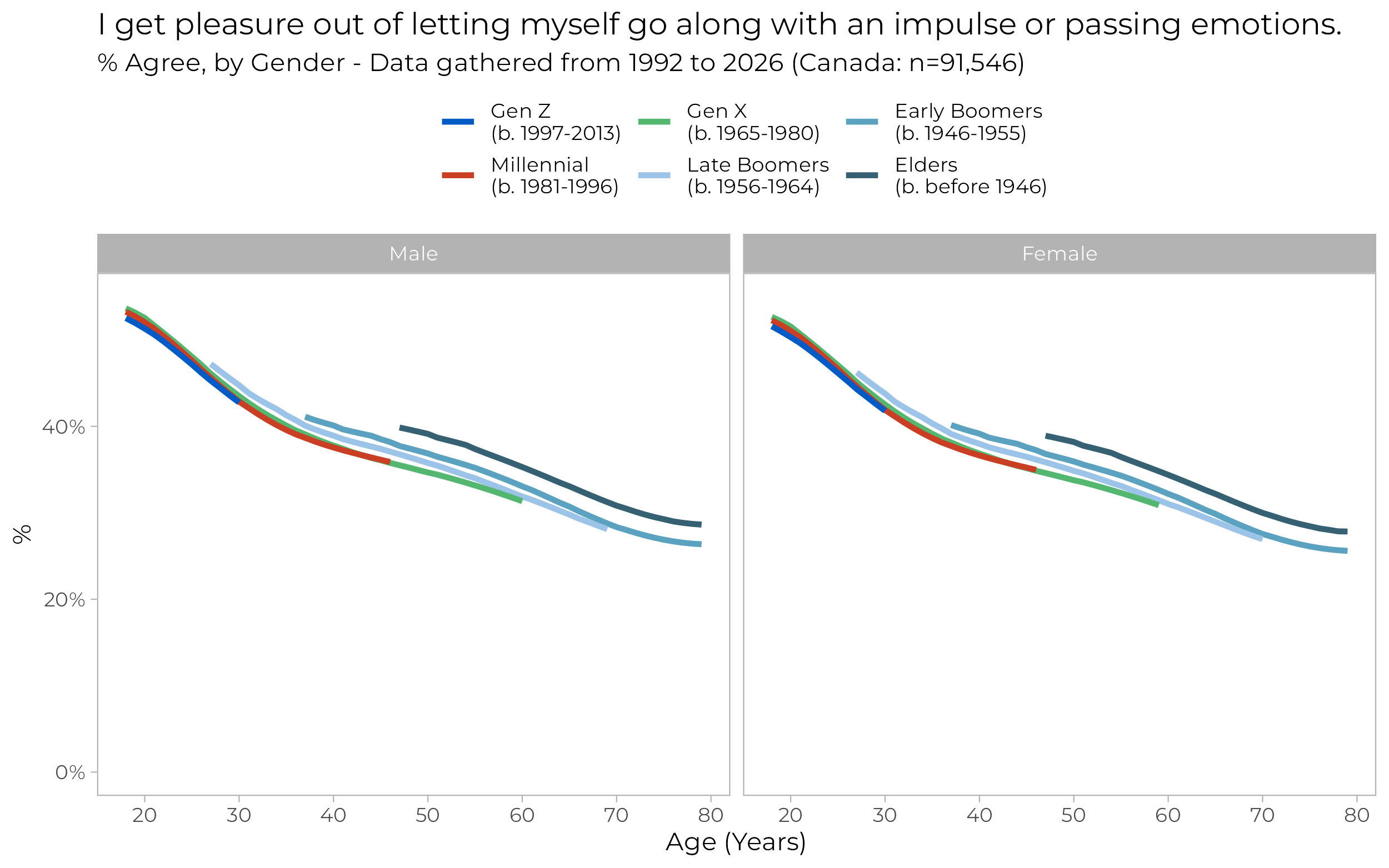
Risk-Taking: More About Age Than Generation
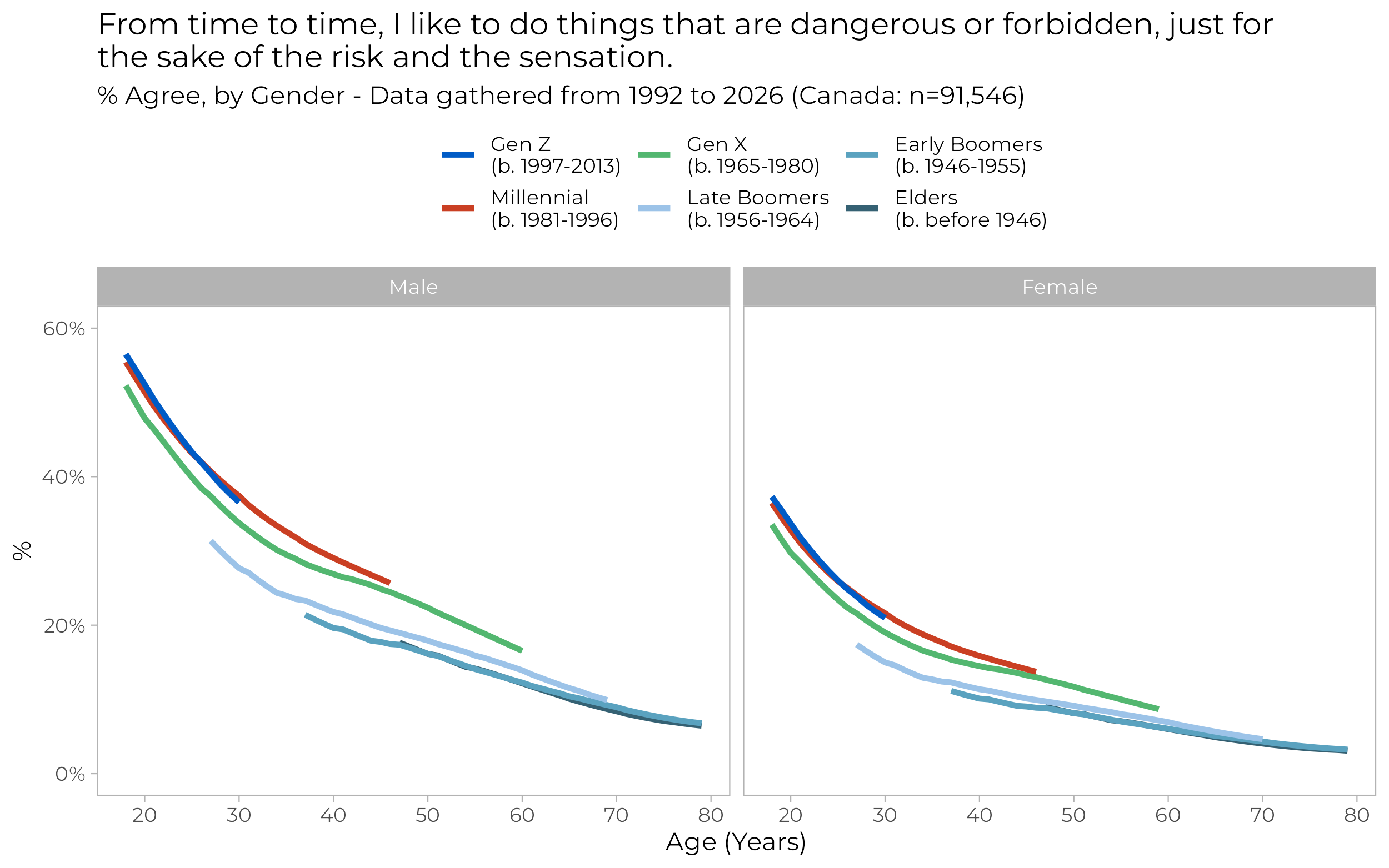
The same pattern applies to some risk-taking concepts. The graphics below show agreement over time with the statement, “From time to time, I like to do things that are dangerous or forbidden, just for the sake of the risk and the sensations.” Agreement is strongest when people are entering adulthood, then declines with age. Agreement is strongest among males (as it was on the emotion/intensity items above), but we see no indication that the Gen Z Canadians are much different from Millennials or Gen X.
Taking Risks to Get Ahead
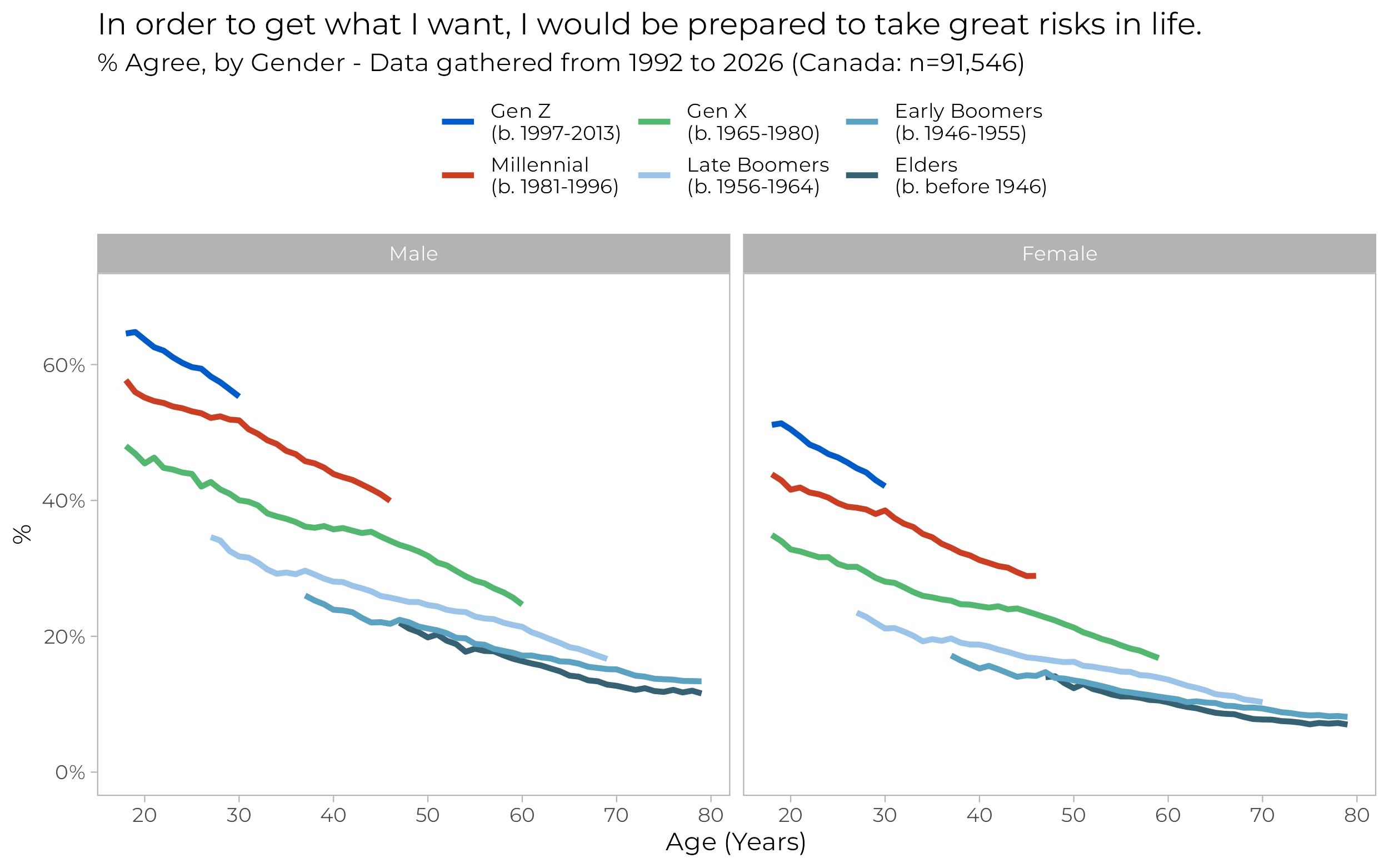
On the statement “In order to get what I want, I would be prepared to take great risks in life” however, something noteworthy is occurring. The difference is not in how people evolve in their agreement level as they age, or in the difference between males and females; on both those aspects, we are seeing the same story play out as with the other statements. What differs here is that each new generation is becoming more likely to agree with this statement from the generation preceding them. What could the reason be?
Financial outlook
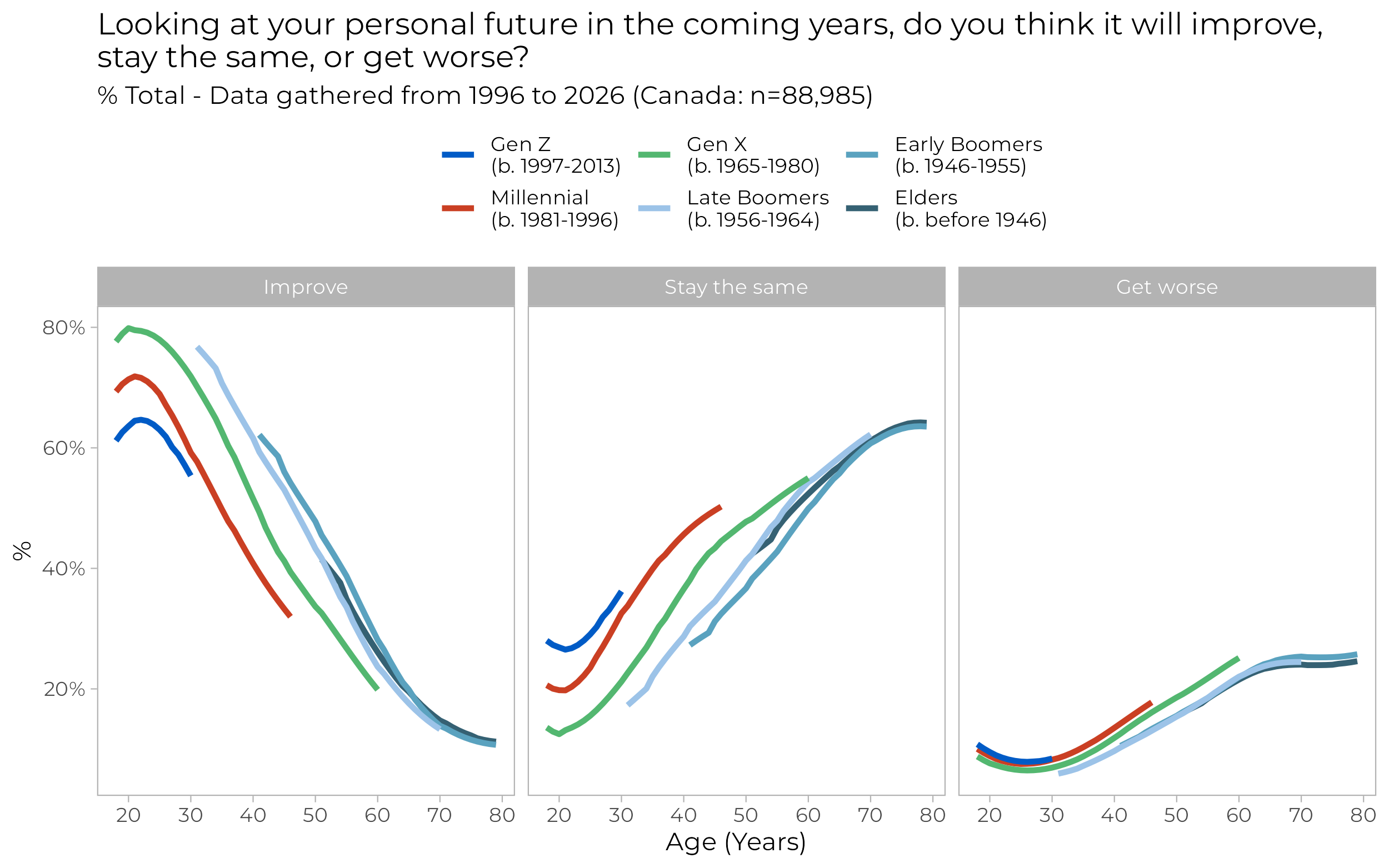
One possible explanation for a greater acceptance of risk to achieve desired rewards is the growing stress felt by Canadians with each passing generation. When asked if they expect their personal future to improve, stay the same, or get worse, each new generation is less likely than the previous one to feel that their own circumstances will improve.
This may reflect what some have described as a “generational squeeze,” with younger Canadians facing growing financial pressures and uncertainty about their ability to achieve the same milestones as previous generations. When traditional pathways to financial security and upward mobility begin to feel increasingly out of reach, the appeal of taking greater risks to get ahead may also change.
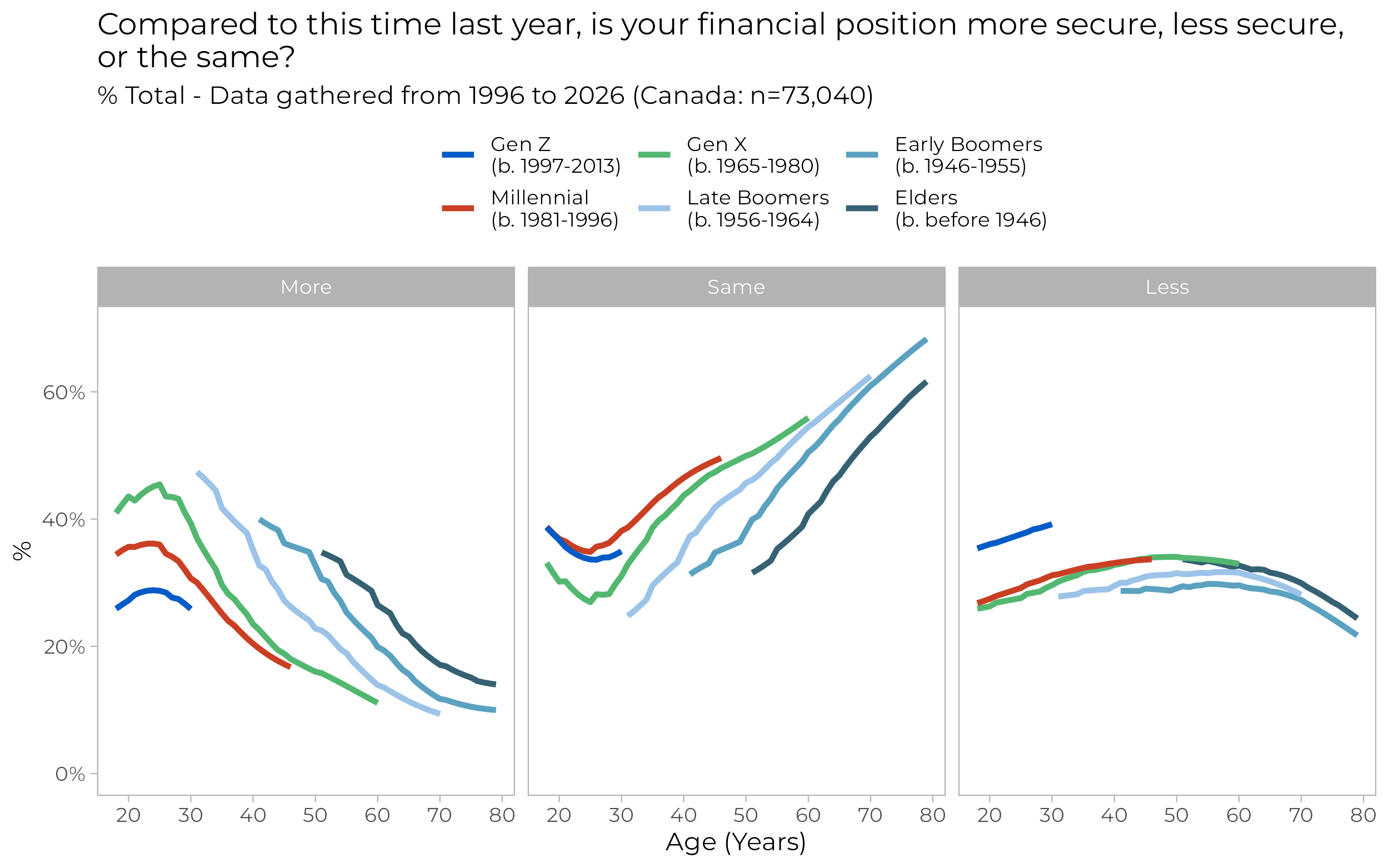
This lack of optimism about their personal future is likely connected to their lack of financial security in the recent past. When we ask Canadians if over the past year their financial position has become more secure, less secure, or the same, we observe that each new generation has become less likely to say that their security has improved. This generational difference holds true at different ages, which means that young people don’t feel they’re gaining ground even during life stages when we might expect them to – for example, as they finish their education and start working full time. Gen Z stands out notably in that they are far more likely than past generations (at the same age) to say their financial position has become less secure.
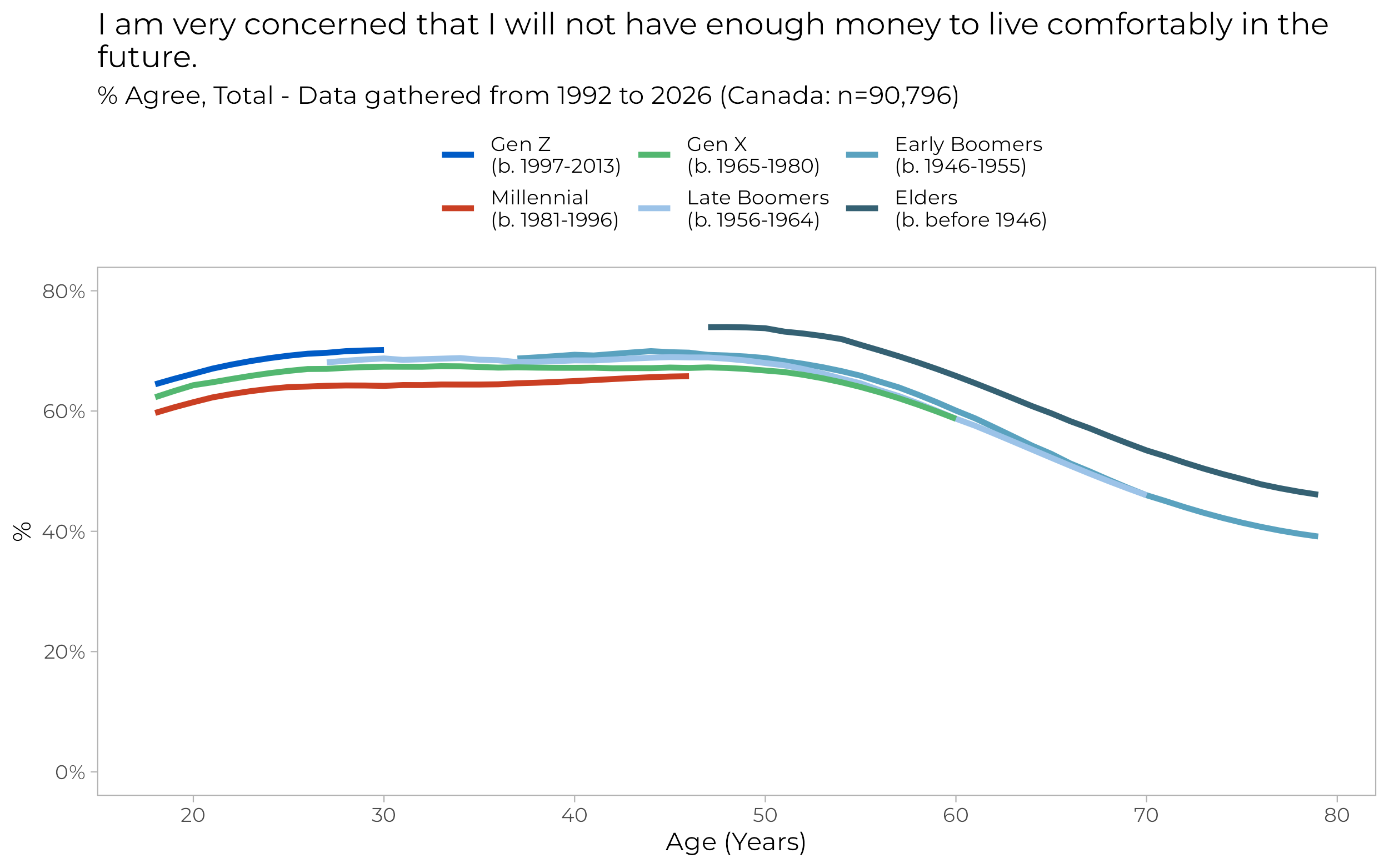
Financial Insecurity Weighs Heaviest on Gen Z
Agreement with the statement “I am very concerned that I will not have enough money to live comfortably in the future” has shown a similar pattern for decades: each generation has been a little less concerned than the last. Gen Z breaks the pattern: they are the most likely generation to agree with the statement to date.
Understanding the Values Behind Youth Gambling
What do these values findings mean for youth gambling? A quest for strong emotion may be part of the story. But Gen Z’s highly distinctive financial outlook – characterized by insecurity and concern for the future – suggests that the gambling risks young people are taking may not be driven solely by sensation-seeking or even a lack of self-control. For Gen Z, risk-taking may also reflect a growing sense that conventional paths to financial security and a better future are becoming less attainable.
Gambling may hold special appeal not only as entertainment but as a release valve for both financial aspirations and frustrations. For many young people, financial insecurity is combined with declining optimism that they can change their circumstances through choices traditionally understood as wise and effective: saving consistently, investing carefully, sacrificing immediate gratification in pursuit of long-term goals like homeownership. If these “good” choices no longer seem to work, maybe risky choices now seem less “bad” by comparison – especially given that the range of betting options has expanded (from house-always-wins casino activity to a proliferation of sports betting and online trading offerings – and in the United States wide-ranging prediction markets). These betting options aren’t exactly surefire wealth-building practices, but nor are they quite as silly as playing roulette instead of saving up for a downpayment in the economy of 30 years ago.
Pressures may be further amplified by social media, where younger people are regularly exposed to images of wealth, success and lifestyles that can feel increasingly unattainable. The combination of financial insecurity, declining optimism and constant comparison with others may create conditions in which taking significant financial risks begins to feel more justifiable, or even necessary, to get ahead.
These distinctions raise important questions for organizations seeking to improve responsible gambling initiatives. How much of younger people’s gambling is driven by the pursuit of excitement, and how much might reflect a perceived need to find alternative ways of getting ahead? The two motivations are not mutually exclusive, but understanding their relative influence could have important implications for prevention. While our Social Values research does not directly measure gambling motivations, the generational shifts we observe in attitudes toward risk, financial security and the future suggest an important hypothesis worth exploring further. Approaches focused only on impulsivity or thrill-seeking may overlook the broader pressures shaping how younger generations understand risk and reward. Testing these connections could help inform prevention strategies that better reflect young people’s lived realities.
About The Research
Environics Research has been running the Social Values research project over a 30-year span in Canada. With a sample size that is nearing 100,000 respondents over 3 decades, we are able to run analyses that observe the evolution on the statements measured across Canadians’ life stages and how these evolutions may differ across generations.
Nonetheless, breaking the sample down to individual years of age and generation results in small sample sizes, making the results too noisy to identify any patterns in the data. To solve this, a logistic multilevel Bayesian model is used as a smoothing technique to cut through the sampling noise and identify what those patterns are across life stages and generations. The charts as presented display the output of these models.