
In early March, King’s College London released an international study on gender relations that concluded men of Generation Z are more likely to believe in gender inequality than are men of the Baby Boomer generation.
While differences in attitudes among people of different ages can be interesting, they always carry uncertainty.
The Ask
Are these findings true generational differences, or are they products of life stage? Put another way, when Baby Boomer men were younger (the same age as Gen Z men are today), were their views on gender inequality similar to the view Gen Z men hold now?
Answering this question is much more difficult than conducting a survey at any one time: it requires a longitudinal study on those attitudes spanning decades. Fortunately, Environics Research has a trove of data that enables this kind of analysis. Environics has been measuring statements similar to the ones included in the King’s College study for over 30 years in Canada and in the United States.
Before we dig into the generational analysis, let’s take a look at how the questions Environics has asked over time match up with the items King’s College used in March.
The Environics Social Values and King’s College Studies
The Environics Social Values study includes three agree-disagree questions somewhat similar to the King’s College items:
- In a household where both partners are working, it is not right for the wife to earn more than the husband.
- Men have a certain natural superiority over women, and nothing can change this.
- The father of the family must be master in his own house.
While the statements from the two studies do not match exactly, there are similarities in spirit which allow for a rough comparison. The closest statements from the King’s College study to the Environics Social Values statements are:
- It causes problems in a marriage if a woman earns more than her husband.
- A husband should have the final word on important decisions made in his home.
Here are the results of the King’s College study across the 29 countries, broken down by gender and generation.
Here are the results of the latest iteration of the Environics Social Values survey, broken down by gender and generation in Canada and in the United States:
In a household where both partners are working, it is not right for the wife to earn more than the husband.
In Canada:
In the United States:
The father of the family must be the master in his own house.
In Canada:
In the United States:
Men have a certain natural superiority over women, and nothing can change this.
In Canada:
In the United States:
The Environics findings directionally line up with the findings from the King’s College study in a couple of key ways. First, younger generations are more likely than older generations to accept gender inequality (both as a fact – men are inherently superior – and as a normative proposition about how families should be organized). Second, although this pattern is true for both men and women (Gen Z men and women are both more accepting of gender inequality than are Boomers of either gender), the gap between men and women within each generation is growing. That is, young men and women differ more from each other than older men and women do.
Back To Our Original Question
How do these views evolve over the life stages of each generation? We’ll turn to the full database of the Social Values spanning over 30 years to determine this. The following charts provide a breakdown of the evolution in agreement.
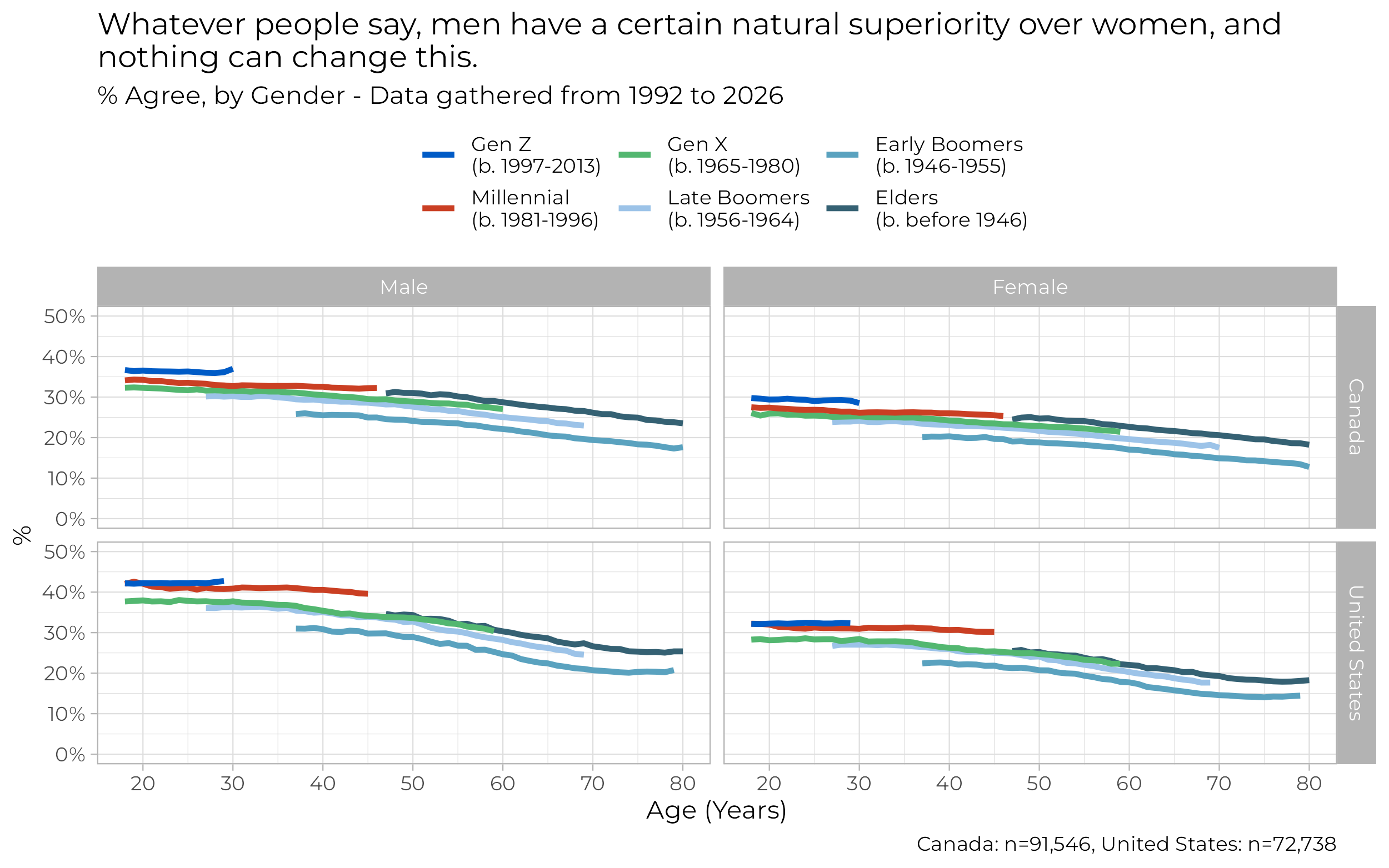
Findings on each question are represented in four squares, showing men (left squares) and women (right) in Canada (top squares) and the United States (bottom). Within each square, the percentage agreeing with the statement is shown on the vertical (Y) axis, while age progression is shown on the horizontal (X) axis. So a line that slopes down and to the right, for example, indicates that members of a given cohort become less likely to agree with a given statement as they age.
On the statement “In a household where both partners are working, it is not right for the wife to earn more than the husband”, younger cohorts today are indeed more likely to agree – even when compared to other cohorts at the same age. For example, in the upper-left square, we see more than one-quarter of Gen Z men at age 20 agreeing, compared to just over 10 per cent of Gen X men at the same age. The pattern holds both in Canada and in the United States. In fact, unless the trend line changes, members of Gen Z appear on track to exceed the pre-Boomers in their agreement. That is, in middle age, Gen Z may be more insistent on male economic dominance than their great grandparents were at the same age.
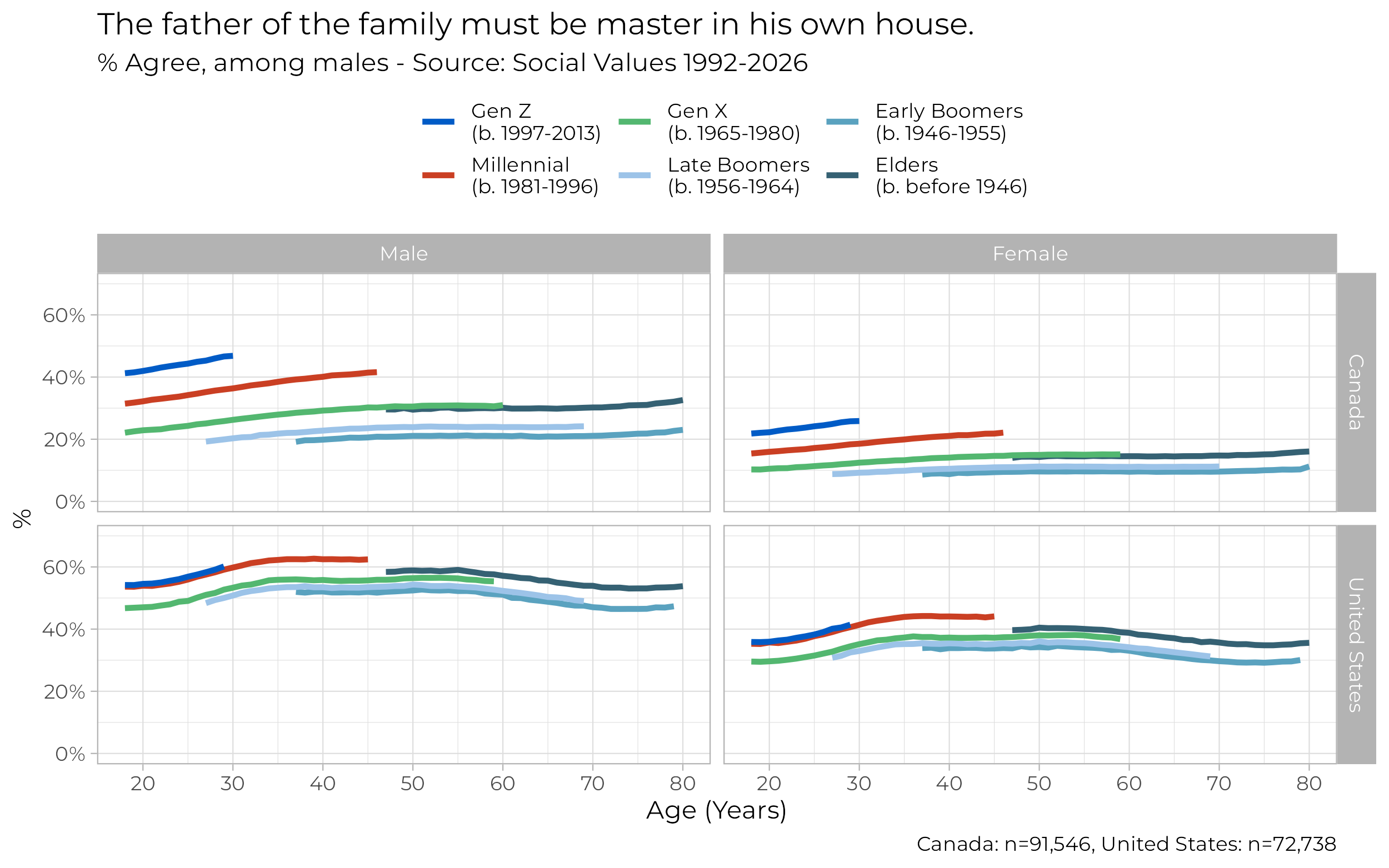
On the statement “The father of the family must be master in his own house”, we again see an increase in the level of agreement from the Gen X to Millennials and Gen Z. Interestingly, while Gen Z and Millennials hold the same levels of agreement in the United States across the portion of their lifespan we’ve measured so far, Canadian members of Gen Z are more likely than Canadian Millennials to agree with the statement.
It’s also notable that agreement with this statement adheres to a different pattern than the other two items. On the other two statements, people tend to agree less as they age (a pattern that holds across cohorts). By contrast, the belief that “father must be master” tends to hold steady, or even rise slightly, as people age.
On the statement “Men have a certain natural superiority over women, and nothing can change this”, we are again seeing younger generations more likely to agree, and here again the difference is not explained by life stage.
It is also noticeable how regardless of generation, people become less likely to agree with the statement as they live through their life, with the exception of pre-Boomers in the United States, where a reversion is observed in their 80s and beyond.
In conclusion, our findings not only line up with the findings from King’s College London, they affirm that the King’s College findings are not a misleading point-in-time snapshot. Views affirming or supporting gender inequality have become more prevalent with each successive generation. This finding suggests that challenges related to gender equality in the workplace and in society in general will increase in the years ahead, as older generations pass on, and younger generations make up the bulk of the population and gain power in businesses and institutions. Further research would be needed to explain why, after Baby Boomers led an embrace of gender equality beginning in the post-war decades, we see a reversal in this evolution among younger generations, especially Millennials and Gen Z.